

Villeray
Snapshot of
Villeray
Discover key facts
👩🦰 Population – high concentration of young adults
The neighborhood is distinguished by a strong presence of young adults aged 18 to 34 (33%), with lower proportions of children (16%) and seniors (12%). In Villeray-Est, the proportions of children (17%) and seniors (14%) are slightly higher.
👩👧 Single-parent families – more prevalent in Villeray-Est
35% of families in Villeray-Est are headed by a single parent (1,005 families), above the Montreal average (31%). Other sectors show lower rates: 29% in Villeray-Ouest and 30% in Villeray-Centre.
👴 People living alone and seniors living solo – strong presence
The rate of people living alone in the neighborhood is higher than the Montreal average (24% vs. 19%), particularly in Villeray-Centre (28%). Seniors in all sectors of Villeray are more likely to live alone than in Montreal overall, notably in Villeray-Centre, where more than half (56%) do so.
📍 Poverty – comparable to the Montreal average
11% of the neighborhood’s population (6,525 people) live on low income, a rate equivalent to Montreal. Villeray-Est has both the highest rate (13%) and the largest number of low-income residents (2,800).
👨🏾🤝👨🏼 Diversity and immigration – contrasting picture
The proportion of residents belonging to a visible minority group is significantly lower in Villeray (26%) than in Montreal overall (38%), except in Villeray-Est, where it reaches 39%. Over half (53%) of the neighborhood’s visible minority population resides in Villeray-Est.
🏢 Housing – exceptional cost increase and high core housing needs
Between 2023 and 2025, the Villeray–Saint-Michel–Parc-Extension borough recorded a 71% increase in housing costs, compared with 23% across Greater Montreal, the largest increase on Centraide’s territory. In addition, 13% of households are in core housing need, among the highest proportions in Montreal. These households live in housing that is inadequate, unaffordable or too small.

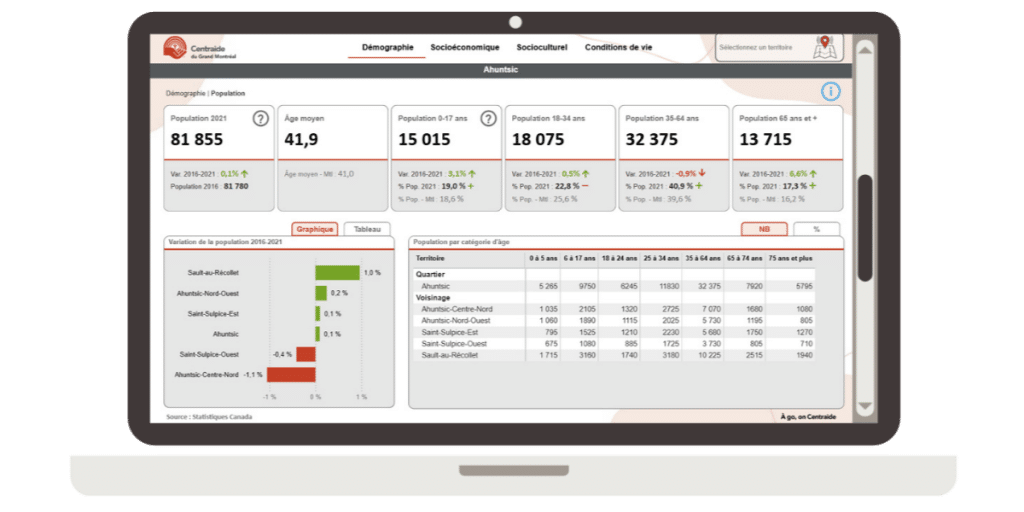
Dashboard
Consult this dashboard to access a wide range of demographic, socio-cultural/economic, and living-condition data.