


Rivière-des-Prairies
Snapshot of
Rivière-des-Prairies
Discover key facts
📍 Poverty – well below the Montreal average
4% of the neighborhood’s population (2,450 people) live on low income, one of the lowest rates on the Island of Montreal (11%). The rate is slightly higher in the western sector (5%), where 71% of all low-income residents in the neighborhood live (1,740 people). In both sectors, children aged 0 to 5 are the most affected by poverty, unlike the rest of Montreal, where adults are generally the most at risk.
✏️ Low educational attainment (without a high school diploma) – above the Montreal average
Among adults aged 25 to 64, 13% (3,715 people) do not have a high school diploma, higher than the Montreal average (9%). The majority of these adults (63%, or 2,360 people) live in the western sector of the neighborhood.
🌎 Immigrant population – long-established neighborhood
Immigrants represent 35% of the population (19,915 people), slightly above the Montreal average (33%). Rivière-des-Prairies stands out for having the highest proportion on the island of immigrants settled for more than five years: 95% of the immigrant population, compared with 83% in Montreal. 37% of them (13,410 people) live in the western sector.
👨🏾🤝👨🏼 Diversity – visible minority presence
38% of residents (21,750 people) belong to a visible minority group, a rate equal to the Montreal average (38%). These residents are more concentrated in the western sector (13,650 people).
🏢 Housing – high concentration of renter households spending too much on housing in the western sector
The vast majority of renter households spending too much of their income on housing live in the western sector (85%). This sector also has the highest proportion of renters spending too much on housing (31%, compared with 21% in the eastern sector and 28% on the Island of Montreal). Although rents remain below the island average, housing costs increased more rapidly in the neighbourhood between 2023 and 2025 (31% versus 28%).

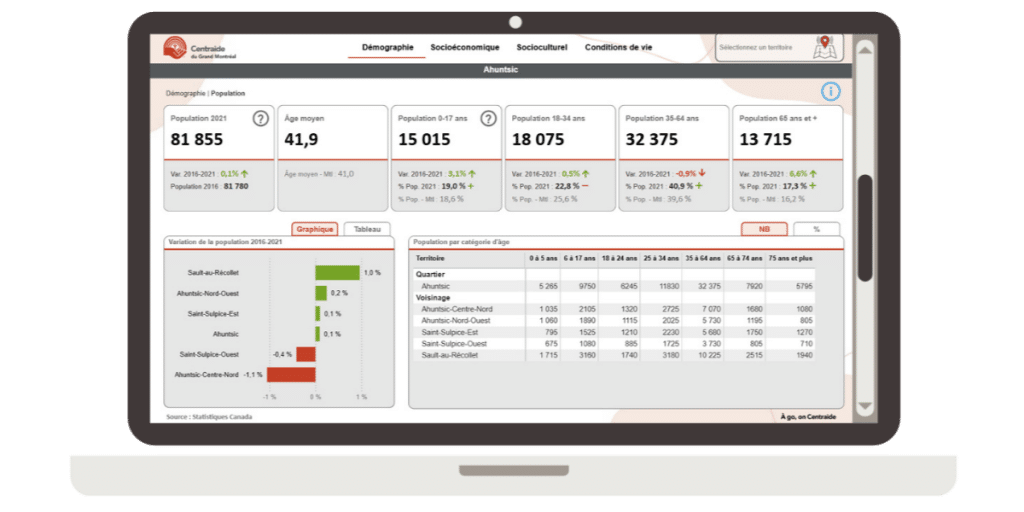
Dashboard
Consult this dashboard to access a wide range of demographic, socio-cultural/economic, and living-condition data.