

Anjou
Snapshot of
Anjou
Discover key facts
👵 Age pyramid – a contrasting profile
While Bas-Anjou has a quarter of its population under age 18 (25%, compared to 19% in Montreal), Jean-XXIII stands out with a high proportion of seniors, representing 21% of the population, well above the Montreal average (16%).
👶🏻 Poverty – more pronounced among children aged 0–5
The low-income rate is 8%, slightly below the Montreal average (11%), representing 3,255 people. Children aged 0 to 5 are the most affected: 12% (335 children) in the neighbourhood as a whole, 11% (200 children) in Bas-Anjou, and 12% (130 children) in Jean-XXIII—rates slightly higher than the Montreal average (10%).
✏️ Low educational attainment (without a high school diploma) – more pronounced among adults aged 25–64
12% of adults aged 25 to 64 (2,560 people) do not have a high school diploma, compared to 9% in Montreal. Bas-Anjou has the largest number of undereducated adults (1,490 people), followed by Jean-XXIII (1,055 people).
🌎 Immigrant population – higher than the Montreal average, with non-permanent residents concentrated in Bas-Anjou
37% of the population (15,670 people) is immigrant, a rate higher than in Montreal (33%). Bas-Anjou attracts the majority of non-permanent residents: three-quarters of them (73%, or 1,230 people), 65% of whom are asylum seekers.
👨🏾🤝👨🏼 Diversity – strong presence of visible minority groups in Bas-Anjou
The proportion of residents belonging to visible minority groups is 39% in the neighbourhood, comparable to Montreal (38%). Bas-Anjou exceeds the average with 43% and has the largest number of people in this group (10,070 residents, compared to 6,605 in Jean-XXIII).
🏡 Housing – sharp cost increase
Between 2023 and 2025, housing costs increased more rapidly in the neighbourhood than on the Island of Montreal (32% versus 28%). Despite this increase, the average rent for a two-bedroom apartment remains below the Montreal average ($1,262 versus $1,361 in 2025).

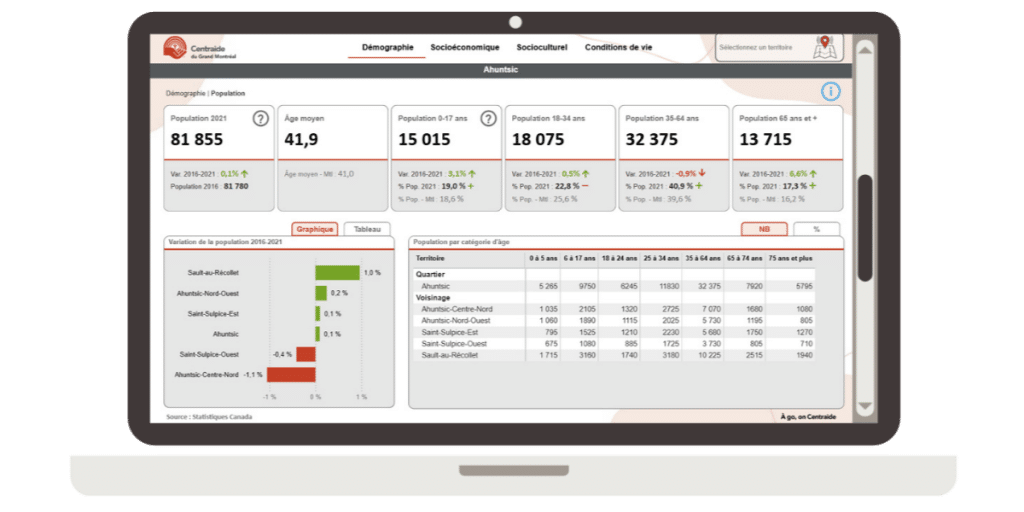
Dashboard
Consult this dashboard to access a wide range of demographic, socio-cultural/economic, and living-condition data.