

Parc-Extension
Snapshot of
Parc-Extension
Discover key facts
📍 Poverty – very high
The neighbourhood’s low-income rate reaches 21%, the second highest in Montreal after Peter-McGill, and twice the Montreal average (11%). This situation affects all age groups (0–17, 18–64, and 65 and over). Families, whether single- or two-parent, are particularly affected, and the median household income, at $44,800, ranks as the second lowest on the island, well below the Montreal average ($58,000).
🌎 Immigrant population and asylum seekers – strong presence
Nearly one in two residents in the neighbourhood is an immigrant (45%, or 12,840 people), compared to one-third in Montreal (33%). The neighbourhood also hosts the second largest population of asylum seekers on the island after Montréal-Nord, with 3,940 people.
✏️ French proficiency and low educational attainment (without a high school diploma) – limited and high
53% of neighbourhood residents speak French, one of the lowest rates on the island. In addition, 11% speak neither French nor English, well above the Montreal average (2%). Among adults aged 25 to 64, 25% are undereducated, meaning they do not have a high school diploma, more than double the Montreal average (9%).
👨🏾🤝👨🏼 Diversity – the most diverse neighbourhood in Montreal
68% of residents, nearly 20,000 people, belong to visible minority groups. This rate, the highest on the island, far exceeds the Montreal average of 38%.
🏢 Housing – exceptional cost increase and high core housing needs
Between 2023 and 2025, the Villeray–Saint-Michel–Parc-Extension borough recorded a 71% increase in housing costs, compared with 23% across Greater Montreal, the largest increase on Centraide’s territory. In addition, 17% of households are in core housing need, the highest proportion among all Montreal neighbourhoods. These households live in housing that is inadequate, unaffordable or too small.

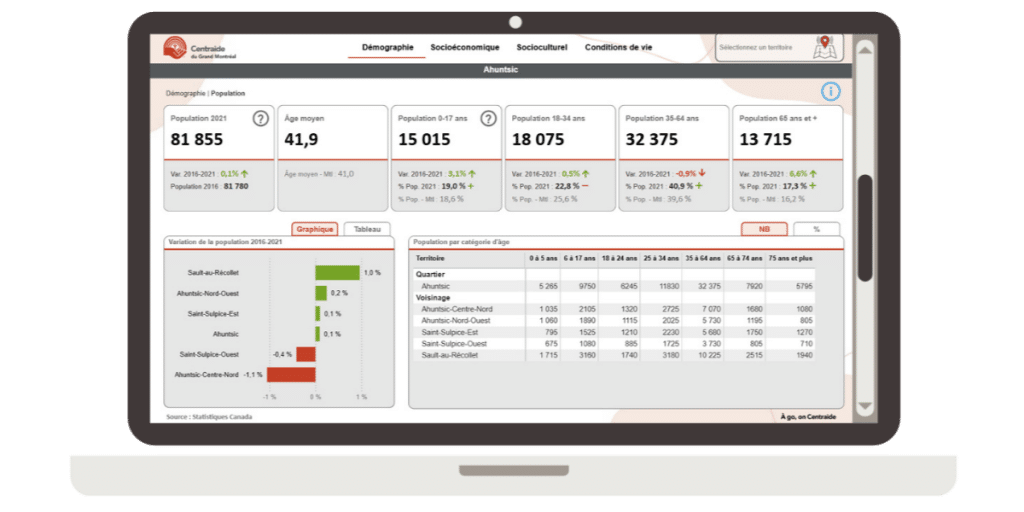
Dashboard
Consult this dashboard to access a wide range of demographic, socio-cultural/economic, and living-condition data.