

Montréal-Nord
Snapshot of
Montréal-Nord
Discover key facts
👩👧 Single-parent families – strong presence
40% of families are single-parent, a rate above the Montreal average (31%). In the Northeast sector of the neighbourhood, one in two families (53%) is single-parent. Montréal-Nord has the largest number of single-parent families of all Montreal neighbourhoods.
👶🏻 Poverty – more pronounced among children aged 0–5
The neighbourhood has 10,255 low-income residents, representing 12% of its population, slightly above the Montreal average (11%). In the Northeast sector, the rate rises to 19%. Children aged 0 to 5 are particularly affected, with a rate of 17% in almost all sectors of the neighbourhood, contrasting with the rest of Montreal, where adults are generally the most affected by poverty.
✏️ Low educational attainment (without a high school diploma) – more pronounced among adults aged 25–64
22% of adults aged 25 to 64 do not have a high school diploma, more than double the Montreal average (9%). Montréal-Nord has the largest undereducated adult population in Montreal (9,705 people). In the Northeast sector, this proportion reaches 31%.
🌎Immigrant population and asylum seekers – strong presence
39% of the neighbourhood’s population, or 33,350 people, are immigrants, a rate above the Montreal average (33%). This rate reaches 46% in the Southwest sector. The immigrant population in the neighbourhood is therefore among the largest in Montreal. Montréal-Nord also stands out for hosting the largest number of asylum seekers on the island, with 5,590 people.
👨🏾🤝👨🏼 Diversity – strong presence of visible minority groups
57% of Montréal-Nord’s population, 62% in the Northeast sector, and 66% in the Southwest sector belong to visible minority groups, compared to 38% in Montreal. In absolute numbers, 48,930 people belong to these groups, making Montréal-Nord one of the most diverse neighbourhoods on the island.
🏢 Housing – sharp cost increase and high core housing needs
Between 2023 and 2025, the average rent for a two-bedroom apartment increased by 37%, compared with 28% on the Island of Montreal, one of the largest increases across Centraide’s territory. In 2025, the average rent reached $1,126, below the island average ($1,361). In addition, 15% of households are in core housing need, one of the highest proportions among Montreal neighbourhoods. These households live in housing that is inadequate, unaffordable or too small.

Dashboard
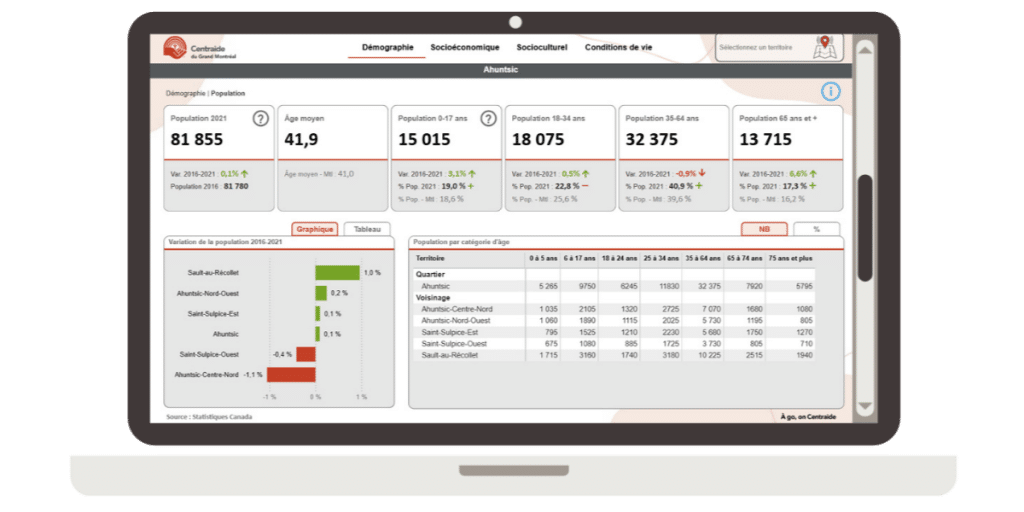
Consult this dashboard to access a wide range of demographic, socio-cultural/economic, and living-condition data.