



Poverty affects
more people than most of us realize
Annual poverty rates in Greater Montreal have ranged between 10% and 12% since 2020. But when we track the same people over an eight-year period, a broader pattern emerges: 26% of adults lived below the poverty line for at least one year between 2016 and 2023.¹
This is the finding of a study on persistent and temporary poverty in the area served by Centraide of Greater Montreal, conducted in collaboration with the Institut national de la recherche scientifique (INRS).
The study provides one of the most detailed profiles to date of persistent poverty in Greater Montreal, drawing on data covering nearly 100 geographic areas across the Island of Montreal, Laval and the South Shore.
What are the low-income measure thresholds based on the LIM-AT?1
- $30,824 for a one-person household
- $61,648 for a four-person household
How does the study define temporary poverty and persistent poverty?
- Temporary poverty: One to two years below the poverty line
- Persistent poverty: Three to eight years below the poverty line
◦ Moderately persistent: Three to six years below the poverty line
◦ Highly persistent: Seven to eight years below the poverty line - Poverty (all situations): One to eight years below the poverty line
🔍 What do the study’s findings tell us?

Poverty is more prevalent than one might think
More than one in four adults (26%) lived below the poverty line for one or more years between 2016 and 2023.
Tracking people over eight years instead of a single year has a significant impact on the overall poverty landscape.
Over this period (2016 to 2023), 26% of adults in the Montreal census metropolitan area (CMA) experienced at least one year of poverty: 14% persistently and 12% temporarily. This is more than twice the annual percentage observed from 2020 onward, which ranged from 10% to 12%.
Although many areas in Quebec have seen significant progress in this regard since the late 1990s, the proportion of people in Greater Montreal who experienced at least one year of poverty remained fairly flat.

Poverty is more often long-term than short-term
Persistent poverty is more common than temporary poverty.
The study distinguishes between episodes of temporary poverty and situations that last for several years.
In Greater Montreal in 2023:
- 12% of adults had experienced temporary poverty (one or two years out of eight)
- 14% had experienced persistent poverty (three to eight years out of eight)
◦ 8% had experienced moderately persistent poverty (three to six years out of eight)
◦ 6% had experienced highly persistent poverty (seven to eight years out of eight).
More than 70% of those living below the poverty line in the Montreal CMA in 2022 remained there in 2023.

Greater Montreal has the highest poverty rates among all CMAs in Quebec
Poverty is more widespread in Greater Montreal, mainly because the risk of entering poverty is higher.
Greater Montreal differs from other CMAs in Quebec, with higher rates of both persistent and temporary poverty and a sharper increase in highly persistent poverty in recent decades (from 5% in 1999 to 6% in 2023).
The study shows that this gap is primarily attributable to a higher risk of entering poverty rather than greater difficulty in exiting it. Immobility rates among people living in poverty are comparable to those observed elsewhere in the province.
This highlights the importance of taking action as early as possible to prevent people from falling below the poverty line in the first place.

Poverty is more widespread on the Island of Montreal than it is in Laval or on the South Shore
Both temporary and persistent poverty are much more prevalent on the Island of Montreal than in Laval or on the South Shore.
Between 2016 and 2023, 34% of adults living on the Island of Montreal were below the poverty line for one or more years, compared to 23% in Laval and 20% on the South Shore.
The Island of Montreal also has the highest proportion of persistent poverty, with 20% of the population having lived below the poverty line for three or more years, compared to 12% in Laval and 10% on the South Shore.
Marked disparities endure from one area to another
Persistent poverty is concentrated in certain areas and is much less prevalent in others.
The highest rates of persistent poverty are found in the central and eastern parts of the Island of Montreal. Topping the list are Parc-Extension (39%) and Petite-Bourgogne (35%).
The rates are much lower in several South Shore municipalities, including Sainte-Julie, Saint-Basile-le-Grand, Saint-Bruno-de-Montarville, Boucherville and Candiac. In some of these municipalities, more than 90% of adults did not live below the poverty line in any year between 2016 and 2023.
The gap between the two extremes is considerable: the likelihood of experiencing poverty can be many times greater depending on where people live.

Some groups are at higher risk of poverty than others
The risk of persistent poverty varies greatly from one population group to the next.
Between 2016 and 2023, the groups at highest risk were:
- Women (16%)
- Seniors aged 65 and older (19%)
- Immigrants who have been in Canada for more than 10 years (20%) and recent immigrants (22%).
Of these three groups, the most pronounced change was observed among seniors. While only about 1% of people aged 65 and older experienced highly persistent poverty in the late 1990s, this proportion rose to 11% for the eight-year period from 2016 to 2023.
Young adults, meanwhile, had particularly high rates of temporary poverty (21%) and moderately persistent poverty (16%).
Housing challenges and persistent poverty are intertwined
Housing challenges tend to be more prevalent in areas where persistent poverty is higher.
The study shows a close relationship between persistent poverty and core housing need, including housing that requires major repairs, is unaffordable or is too small for the household.
Areas where persistent poverty is highest are generally those where a larger proportion of households experience difficulties in securing adequate housing.
The findings also suggest that neighbourhoods with a high proportion of subsidized housing are better protected in this regard.
📌 Key takeaways
- Between 2016 and 2023, 26% of adults in Greater Montreal lived below the poverty line for at least one year, 14% persistently and 12% temporarily.
- 14% of adults in Greater Montreal experienced persistent poverty during this eight-year period, including 6% who experienced highly persistent poverty.
- Poverty rates are higher in Greater Montreal than in other census metropolitan areas in Quebec, as is the risk of entering poverty.
- On the Island of Montreal, one in three adults experienced at least one year of poverty, compared to about one in five in Laval and on the South Shore.
- Women, immigrants and seniors are more likely to experience persistent poverty.
- There are significant disparities in poverty rates across Greater Montreal, with the highest rates found in the central and eastern parts of the Island of Montreal.
- The areas most affected by persistent poverty are also those with the highest rates of core housing need.
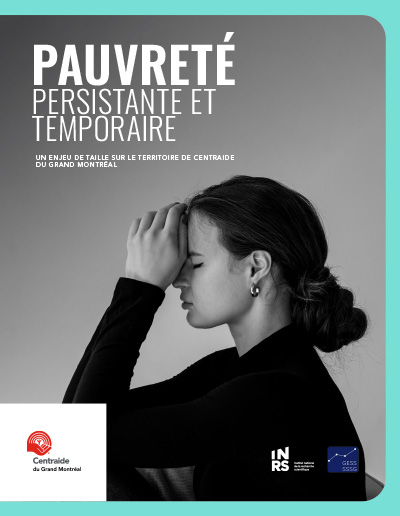
Download the Study Report (French only)
Discover the study Persistent and Temporary Poverty: A Major Challenge in the Areas Served by Centraide of Greater Montreal.
1. The findings are based on the low-income measure, after tax (LIM-AT) and after government transfers. Government transfers include child benefits, employment insurance benefits, certain benefits for seniors and other government payments to households.