



Nearly one in two Quebeckers
is experiencing significant financial anxiety
Quebeckers continue to feel significant pressure due to their finances, according to Centraide’s sixth financial anxiety index survey, conducted in collaboration with Leger.
Nearly 9 out of 10 Quebeckers (86%) report feeling this strain, with nearly one in two (48%) experiencing major financial anxiety (from a moderate to extreme level).
This anxiety has continued to trend upward. Between 2022 and 2026, the average financial anxiety score increased slightly from 38.8 to 40.4.
Behind the numbers: Households feeling financial pressure
Financial anxiety in Quebec continues to be high and on the rise due to a worsening of personal finances and a sharp rise in food insecurity, all of which has significantly impacted people’s quality of life.
The survey findings confirm a reality seen on the ground, with many households having to make harder choices as they see their financial buffer disappear.
Deteriorating finances
Many indicators show that Quebeckers have become more financially vulnerable over the past year.
One in four people (25%) say that their situation has gotten worse in the past six months,
while the percentage of people who feel as if they are in a good financial situation is on the decline.
This deterioration also shows up in households’ ability to cope with unexpected expenses.
Nearly half (45%) have less than a one-month financial buffer to deal with a loss of income or an unexpected expense.
In concrete terms, more households are experiencing some form of financial insecurity, even if they have employment.
Food insecurity: worrying signs
According to the survey, reported food insecurity has risen sharply since 2025, with 30% of Quebeckers in this situation compared to 22% last year.
This means that people are having trouble accessing healthy food or enough food on a daily basis. It is therefore not surprising that food has become the main concern for over half the population (54%), ahead of housing and child-related expenses.
Some groups are facing even greater pressure, particularly young adults, low-income households, and people with a functional impairment.
Specific groups hit hardest
👨👩👧👦 Parents
- 60% of parents are experiencing high financial anxiety.
- Single-parent families are particularly vulnerable and often have to put off important financial decisions related to savings, leisure, and different types of health care.
📉 People with low financial literacy
- Twice as many people with low financial literacy are experiencing severe financial anxiety (62% vs. 33%), which shows the importance of financial knowledge when it comes to managing financial stress.
🧑🎓Young adults
- This group is particularly affected in terms of both their finances and their well-being.
🔍 On our radar
👉Key takeaways from the financial anxiety index:
- 48% of Quebeckers are experiencing moderate to severe financial anxiety.
- 86% are feeling some degree of financial anxiety.
- 1 in 4 people (25%) has recently seen their financial situation get worse.
- 45% have less than a one-month financial buffer.
- 30% are food insecure, which is a strong increase.
A reality that goes beyond Quebec
Data collected across Canada confirm that financial anxiety is a widely shared reality from coast to coast.
- Less than one month of financial reserves
46% in Canada, compared to 45% in Quebec → Nearly 1 in 2 people, both in Canada and Quebec, lack sufficient financial cushioning to deal with unexpected expenses. - Concerning levels of food insecurity
38% in Canada, compared to 30% in Quebec → About 1 in 3 people report having difficulty meeting their food needs. - Deteriorating financial situation (past six months)
27% in Canada, compared to 25% in Quebec → About 1 in 4 people report that their financial situation has worsened recently, reflecting ongoing economic pressure.
To learn more about the data collected across Canada, download the report by completing the form at the bottom of the page.

Do you want to know your own financial anxiety level?
Fill out the survey in a few minutes, get your results and compare them to those of the Quebec population.
What is the financial anxiety index?
Since fall 2022, Centraide of Greater Montreal has been surveying Quebeckers twice a year to understand their financial concerns and track these concerns over time. The results provided here are based on a survey done in collaboration with Leger from February 17 to March 11, 2026 among 2,003 respondents aged 18 and older.
The financial anxiety index is calculated using three indicators:

Financial and family circumstances

Financial
literacy level

Concerns
about financial issues
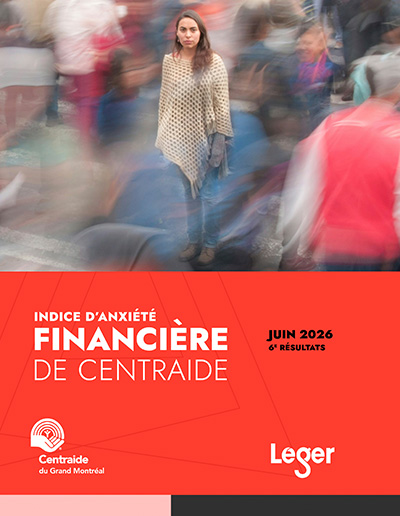
Download the latest report (June 2026)
Survey of 2,003 respondents conducted between February 17 and March 11, 2026. (Available in French only)
In collaboration with:
